Pickleball Court vs Tennis Court: Key Differences
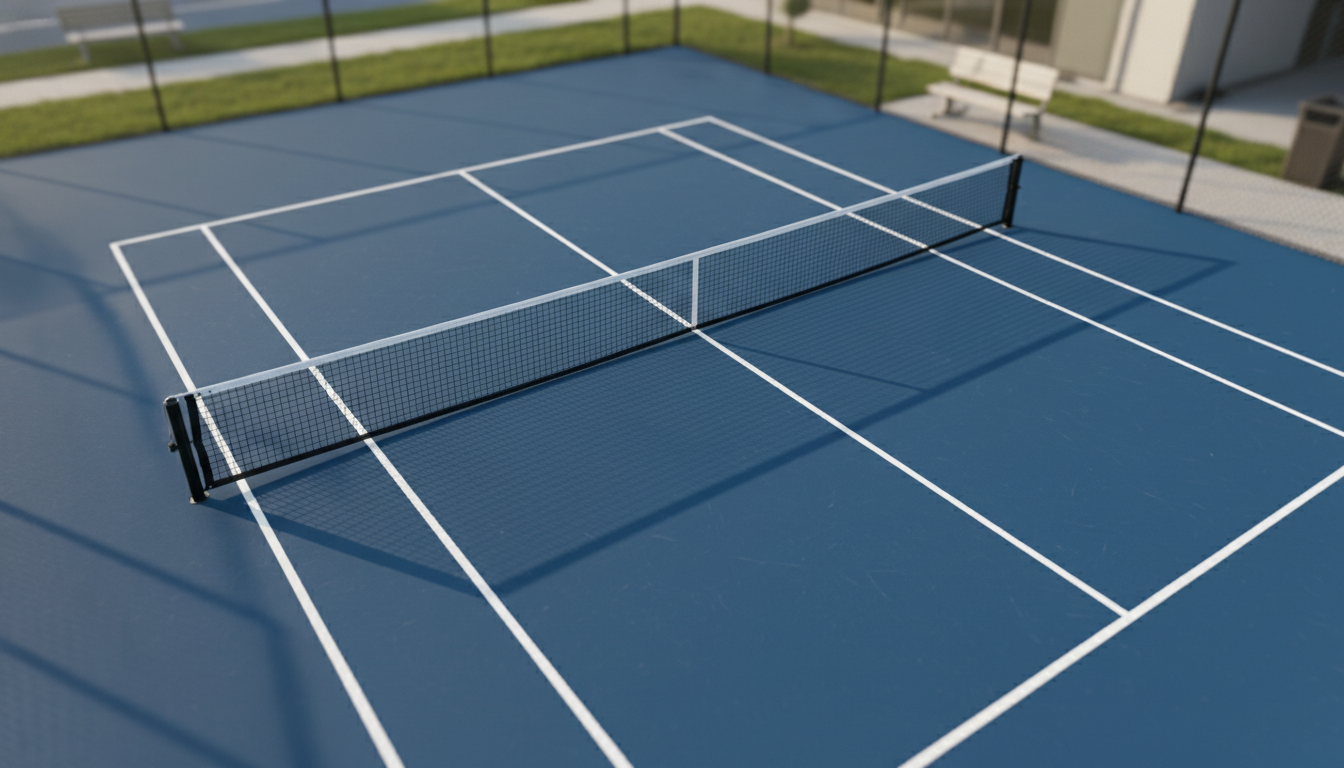
The most common reason someone searches this is to figure out whether they can play pickleball on a tennis court, or to understand why the two sports feel so different spatially. Short answer: yes, you can convert, and the differences are significant enough to matter for your game.
Size Is the Biggest Factor
A standard tennis court is 78 feet long and 36 feet wide (doubles). A pickleball court is 44 feet long and 20 feet wide. That’s less than a third of the total square footage.
The smaller court is why pickleball feels faster and more reactive despite slower ball speeds. You’re covering far less ground, but you’re making decisions in a compressed space with less reaction time at the net.
A single tennis court fits four pickleball courts with room to spare, which is exactly why recreation centers and parks have been converting tennis facilities in bulk. The math works in pickleball’s favor.
Net Height and Posts
Tennis nets sit at 36 inches at the posts and sag to 34 inches at the center. Pickleball nets are lower: 36 inches at the posts, 34 inches at the center—actually the same numbers, but the court is shorter, so the net-to-baseline ratio changes the game considerably.
The practical difference is that on a pickleball court, you’re hitting over that net from a much shorter distance. A 34-inch center net on a 22-foot side (half the 44-foot length) demands flatter, more precise shots than tennis allows with its longer run-up.
If you’re using a temporary pickleball net on a tennis court, make sure it’s rated to proper specifications—some portable nets sold cheaply online run closer to 32 inches at center and will quietly wreck your net clearance habits.
Court Lines and Zones
Tennis has service boxes, a no-man’s-land, and doubles alleys. Pickleball replaces all of that with one critical zone: the non-volley zone, or kitchen, which runs 7 feet from the net on each side.
The kitchen changes everything about court positioning. In tennis, you’re rewarded for rushing net. In pickleball, you can’t volley from inside that 7-foot zone, which forces a specific footwork discipline that has no tennis equivalent.
When a tennis court is converted to pickleball use, the existing tennis lines stay on the court. This creates visual noise. Beginners especially find it confusing to track the correct boundaries when six different sets of lines overlap on the same surface.
Surface and Ball Behavior
Most tennis courts use hard acrylic, clay, or grass. Pickleball is almost exclusively played on hard courts—typically the same acrylic systems used in tennis, like DecoTurf or SportMaster.
The pickleball itself behaves differently by design. Outdoor pickleballs (like the Dura Fast 40 or Franklin X-40) have smaller, harder holes and bounce predictably off hard surfaces. The shorter court means the ball doesn’t need to travel far, and the lower net clearance rewards dink shots that would be trivial in tennis.
Clay tennis courts are rarely used for pickleball, and grass is essentially a non-starter. The ball skids and bounces unpredictably on both surfaces in ways the sport isn’t designed to accommodate.
Playing Tennis on a Pickleball Court (and Vice Versa)
You can’t meaningfully play tennis on a pickleball court—it’s too short for baseline rallies and the net isn’t set up for tennis geometry.
Going the other direction is the common scenario. A tennis court converted to pickleball typically involves:
- Lowering or replacing the net to pickleball spec (or using a portable net centered on the court)
- Taping or painting pickleball lines over existing tennis lines
- Optionally resurfacing for better bounce consistency
Many parks use a dual-line system where pickleball lines are painted in a contrasting color (often yellow or white against the court’s green or blue surface) to make them readable. It works reasonably well once you’ve played on it a few times.
Which Court Is Better for Getting Started?
If you’re new to pickleball and have access to both dedicated pickleball courts and a converted tennis facility, go with the dedicated courts first. The clean lines remove one learning variable.
That said, millions of players learned the game on converted tennis courts, and it’s completely workable. The key adaptations:
- Focus on the kitchen line closest to you—that’s your most important boundary
- Ignore the tennis service boxes entirely; they’re irrelevant to pickleball play
- Check net height before every session if you’re using a portable net
If you’re deciding whether to convert a private tennis court for pickleball use, the conversion cost is modest—primarily the net and court tape—and a standard tennis court gives you enough space for two side-by-side pickleball courts, which makes recreational play significantly more social.
Bottom line: Pickleball courts are roughly one-third the size of a tennis court, use a slightly lower net relative to court length, and introduce the kitchen as a defining feature with no tennis equivalent. Conversion is straightforward and common, but dedicated pickleball courts will always offer cleaner lines and proper playing conditions.