Gearbox CX14H Paddle Review: Who Should Buy It?
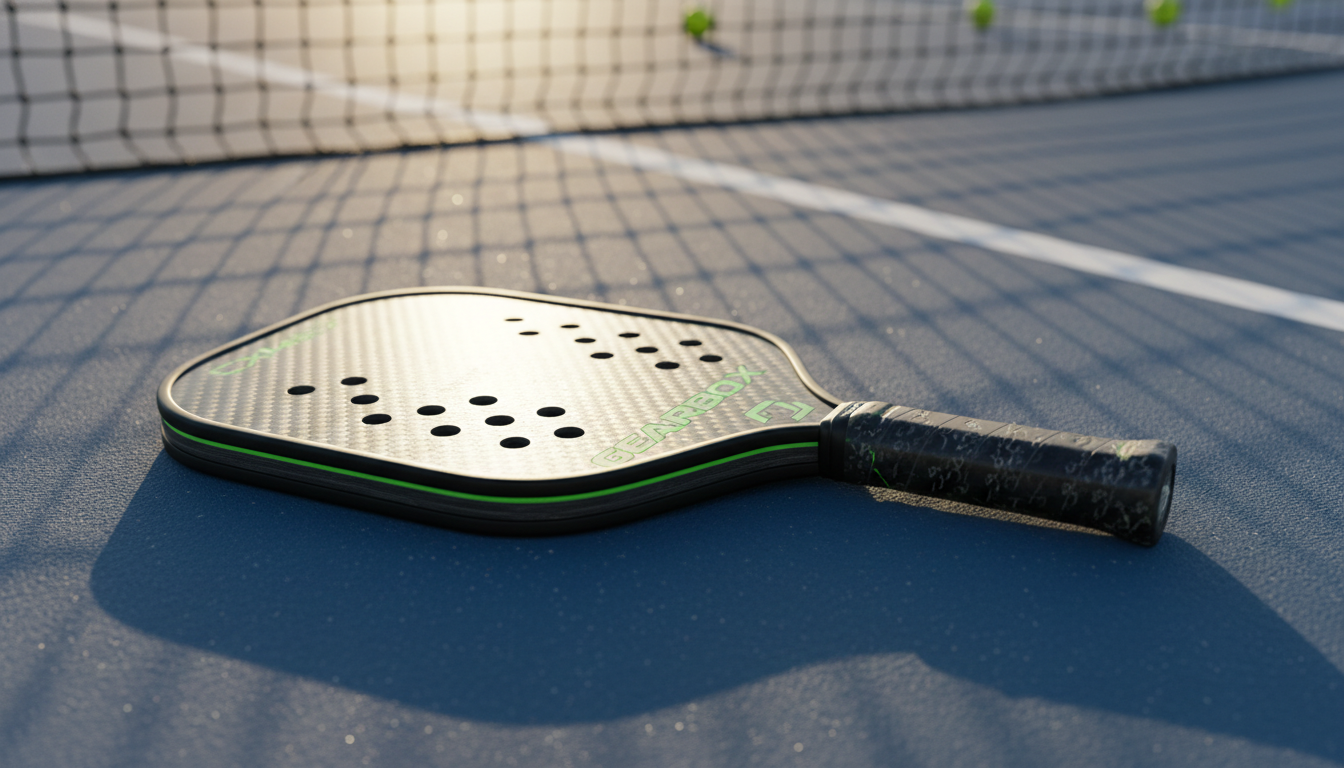
The CX14H is one of Gearbox’s most polarizing paddles—players either love its dense, feedback-rich feel or find it too stiff for their game. If you’re close to pulling the trigger, here’s what you need to know about how it actually plays.
What Makes the CX14H Different
Gearbox builds the CX14H around a solid composite core rather than the polymer honeycomb construction you’ll find in most paddles at this price point. That’s the defining choice. Solid core paddles transmit more direct feedback through the handle, which trained players often describe as “knowing exactly where the ball is on the face.” Less experienced players sometimes read that same sensation as harshness.
The H in the name stands for heavy—the paddle sits in the 8.5–9.0 oz range depending on the unit. That extra mass drives punchier groundstrokes and more stable overhead volleys, but you’ll feel it during long drilling sessions.
The face is textured carbon fiber, which grips the ball well enough for aggressive topspin on the third-shot drop and decent punch volleys at the kitchen. It’s not the grittiest surface on the market—paddles like the Joola Hyperion or Franklin Ben Johns Signature edge it there—but spin generation is more than adequate for intermediate through advanced play.
Power and Pop
The CX14H delivers more pop than most control-labeled paddles. That sounds like a contradiction, but the solid core transfers energy efficiently rather than absorbing it. You don’t need a full swing to get depth on reset shots, which is useful in fast-exchange dinking rallies.
At the same time, the paddle doesn’t feel like a power weapon. Drives land deep without feeling like you’re muscling the ball, but attackers who rely on a big wind-up to generate pace may find the ceiling lower than a raw carbon paddle like the Selkirk Vanguard Power Air.
The sweet spot is centered and moderately sized. Mishits toward the edges lose pace noticeably, which punishes lazy mechanics but rewards consistent contact. That’s a reasonable trade-off for a paddle targeting 4.0+ players.
Control and Dinking
This is where the CX14H justifies its price. The solid core dampens less than polymer, so touch shots require slightly more feel awareness—but once you adjust, the precision payoff is real. Drops from mid-court land softer and more predictably than with many polymer-core paddles that tend to bounce hot.
Kitchen play rewards patience with this paddle. Slow hands and deliberate placement work well. Flick attacks at the NVZ are crisp when timed right, and the grip on the face helps hold the ball slightly longer through angled volleys.
Players coming from a control-oriented polymer paddle (Franklin Pro, Paddletek Tempest Wave) should expect a recalibration period of roughly a week of dedicated play before the solid-core feel becomes intuitive.
Build Quality and Durability
Gearbox’s reputation for build quality is legitimate. The CX14H doesn’t creak, flex, or develop dead spots the way budget paddles sometimes do after a few months of hard use. The edge guard is integrated cleanly, and the handle wrap holds up well over time without getting slick.
The one known issue: the paint and cosmetic layer on the face can scuff visibly faster than the underlying composite. It looks rough after a few weeks of outdoor play, but that’s cosmetic—performance doesn’t degrade with the scuffing.
Gearbox backs the CX14H with a solid manufacturer warranty, and their customer service has a consistently good reputation in the pickleball community.
Who This Paddle Is For
The CX14H is a strong fit if:
- You play at 4.0+ and want paddle feedback, not cushioning
- You prefer finesse and placement over raw pace
- You’re willing to adjust your touch game rather than expect an instant upgrade
- Weight around 8.5–9.0 oz doesn’t bother your elbow or shoulder
Skip it if:
- You have an arm or elbow issue—the stiffer feel amplifies impact more than polymer cores
- You’re a 3.0–3.5 player still building mechanics; the smaller sweet spot will frustrate more than help
- You rely on a heavy spin game as your primary weapon; there are grittier faces available for that
Price and Value
The CX14H typically retails in the $150–$180 range. That’s competitive for a premium solid-core paddle, and Gearbox doesn’t discount often, so waiting for a sale rarely pays off. At that price, it competes directly with the Electrum Model E and the Prolite Bolt. The Gearbox wins on durability and build feel; the Prolite is a better bet if spin is your priority.
For players who’ve been frustrated by polymer paddles that feel unpredictable on reset shots, the price difference over a $90 paddle is easy to justify after the first month of consistent kitchen play.
Bottom line: The Gearbox CX14H is a well-built, feedback-heavy control paddle that rewards technically sound players. If your game is built around placement and you’re at least a solid 4.0, it’s worth the investment. If you’re still ironing out mechanics or have elbow sensitivity, look elsewhere.